
When we step back, who carries on?
Community Engagement Programme (CEP) at DO IN THAI uses 6P and 6R to think through community work: what we want to build together, and what it takes for local people to make decisions and carry on themselves.
When we go to work with a community, we usually have answers ready. What will we do? Who will we work with? How long will it take? What do we hope will happen? We bring good intentions, knowledge and tools. Sometimes we arrive so well prepared that there is barely any room left for the people there to tell us what they want to do with their own lives.
I want us to ask another question, before the work even begins: if one day we are no longer there, who will carry on?
It sounds like a question for the end, something to think about when the project is nearly finished and it is time to hand things over. But if local people are going to live with what we do for a long time, when should they have a say? When we arrive with something to give them? Or while nobody yet knows what needs to be done?
For me, this is a question we have to keep asking ourselves in social development work. Our good intentions can take a project a long way. They can also lead us to occupy someone else's place for too long, while we still feel certain that we are helping.
The work we want to do, and the lives they have to live
Picture two sides. On one are the things we are interested in and the questions we want to work on. On the other are the social issues, the challenges and the people who actually live with them. Of course the two sides see different possibilities. We might see something worth trying. They might see something they have already tried without success, or a whole set of responsibilities we know nothing about.
Finding work we can do together takes time. We have to talk, listen and be willing to move away from our first ideas. People, money, tools and methods all matter. So do time and continuity. We may be working to a project timetable. They have livelihoods, families and seasons to work around. Their lives do not stop and wait for our next visit.
DO IN THAI CEP 6P helps us lay these things out together. Place: what kind of place are we working in? Problem: what is happening, and what makes it difficult to resolve? People: who lives with the problem, and who is affected by it? Then we move to Purpose: what change do we want to see? Programme: what will we do together? And Partnership: who else needs to be involved?
Thinking in this order helps hold us back when our enthusiasm for an activity gets ahead of our understanding of the people. We might want to run a workshop, develop a tool or take students out to try building something. All of that is possible. But we need to be able to come back to whose concerns it addresses, and whether the people we are inviting see its value yet.
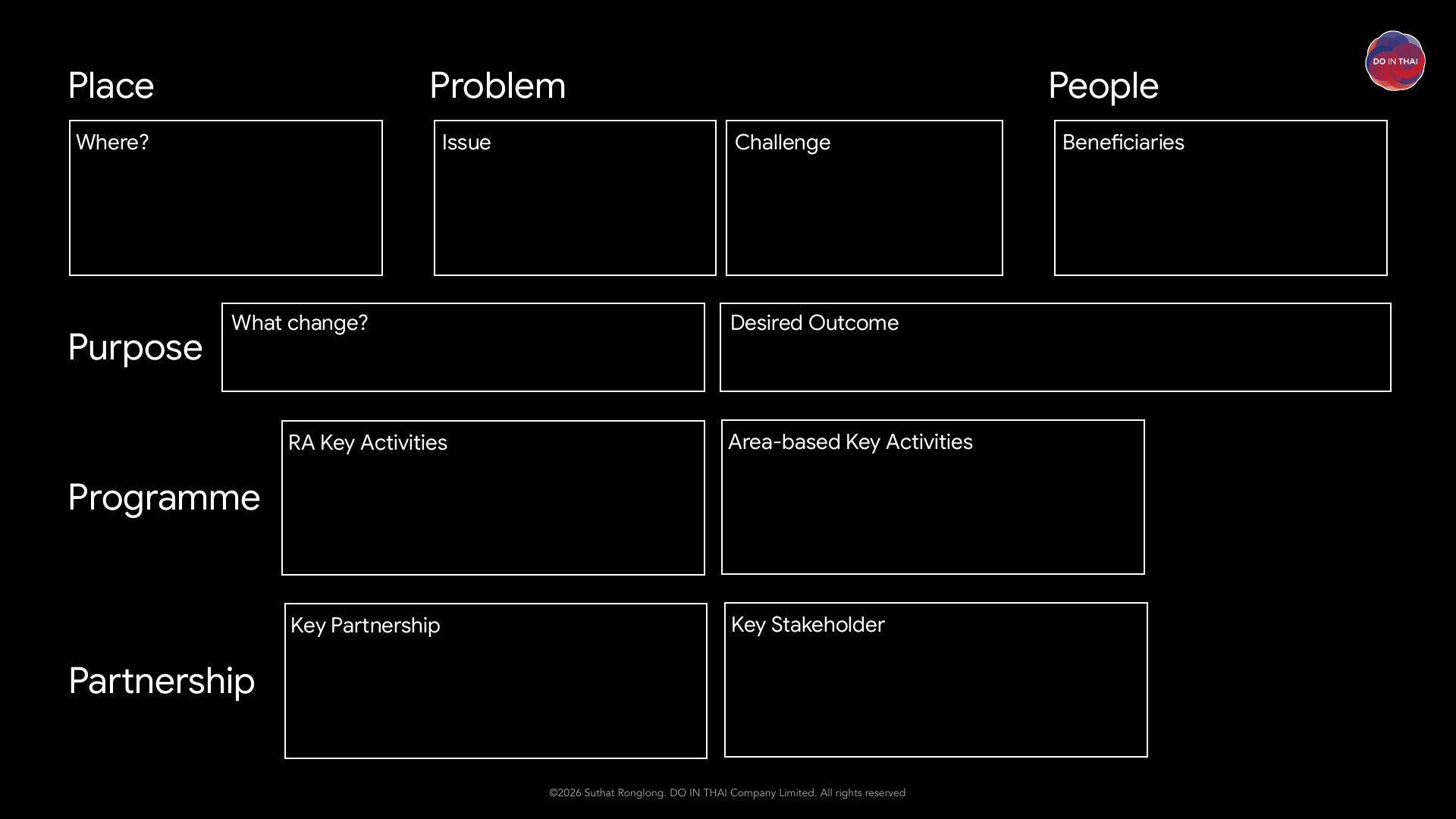
6P: looking at the work we want to do together. View full-size image
By this point, we may have filled in every box. At first glance, we look ready to go. But those people whose names sit next to each other under Partnership: can they actually talk to one another? How much do they trust each other? Who makes the decisions? And is there someone we have not listened to at all?
It is always easier to put everyone's names together on a sheet of paper than to bring them together in real life.
The missing connections
There are gaps between the things we have planned. Adding another activity may do nothing to close them, because they concern the roles, readiness, relationships and ownership of the people who will be working together.
These are the questions behind DO IN THAI CEP 6R. I want us to use them to look at our own way of working as much as at the community.
Role — who are we going in as? Some places need someone to help do the work. Others already have capable people; a few connections are all that is missing. If we arrive in the same role every time, we can end up working very hard at something nobody needs us to do. Ask plainly: does our presence help people do more for themselves? If we step back, can what we started keep moving?
Readiness — how ready are we, and how ready are they? Having a project ready does not mean everyone is ready to take part. Sometimes the first task is to help people see a problem together, so there is something they actually want to work on together. We can hurry an activity along. A sense of ownership is harder to hurry into existence just because our timetable says it is time.
Relationship — how do people in the system relate to one another? Being close to one community leader does not mean everyone in the community trusts each other. There is more to bringing people into a room than arranging the meeting. Who feels able to speak? Who feels they have to hold back around someone else? What would be difficult to live with after it had been said? Without understanding this, we can have a lively discussion in which some important voices are missing the whole time.
Resource — what do we and they already have? Those of us in development work can become very good at spotting what is missing. Stop for a moment and look at what is there: knowledge already in use, people others trust, ways of managing things that may never have been written into a manual. These things belong to people and have a history. They may offer a steadier foundation than the new tool we are eager to bring in. Once we see what is already there, we can better judge what to add and where to let local people lead.
Rights & Responsibility — who decides, and who owns the work? We need to ask this directly. There is a considerable distance between people helping us carry out our work and people helping to think through and decide matters in their own lives. If we still choose and determine everything, then leave them responsible once we go home, what are we handing over? Authority and the ability to act, or just the burden?
Reciprocity — why would they want to carry on? What does each side give, and what does each side get? We may gain knowledge, a body of work or the chance to do something we believe in. Local people give their time and effort, and they will continue to live with the consequences. What value does the work have for them? Is the relationship fair? We need to hear their answers too. Deciding on their behalf that they will certainly benefit would be a little too easy.
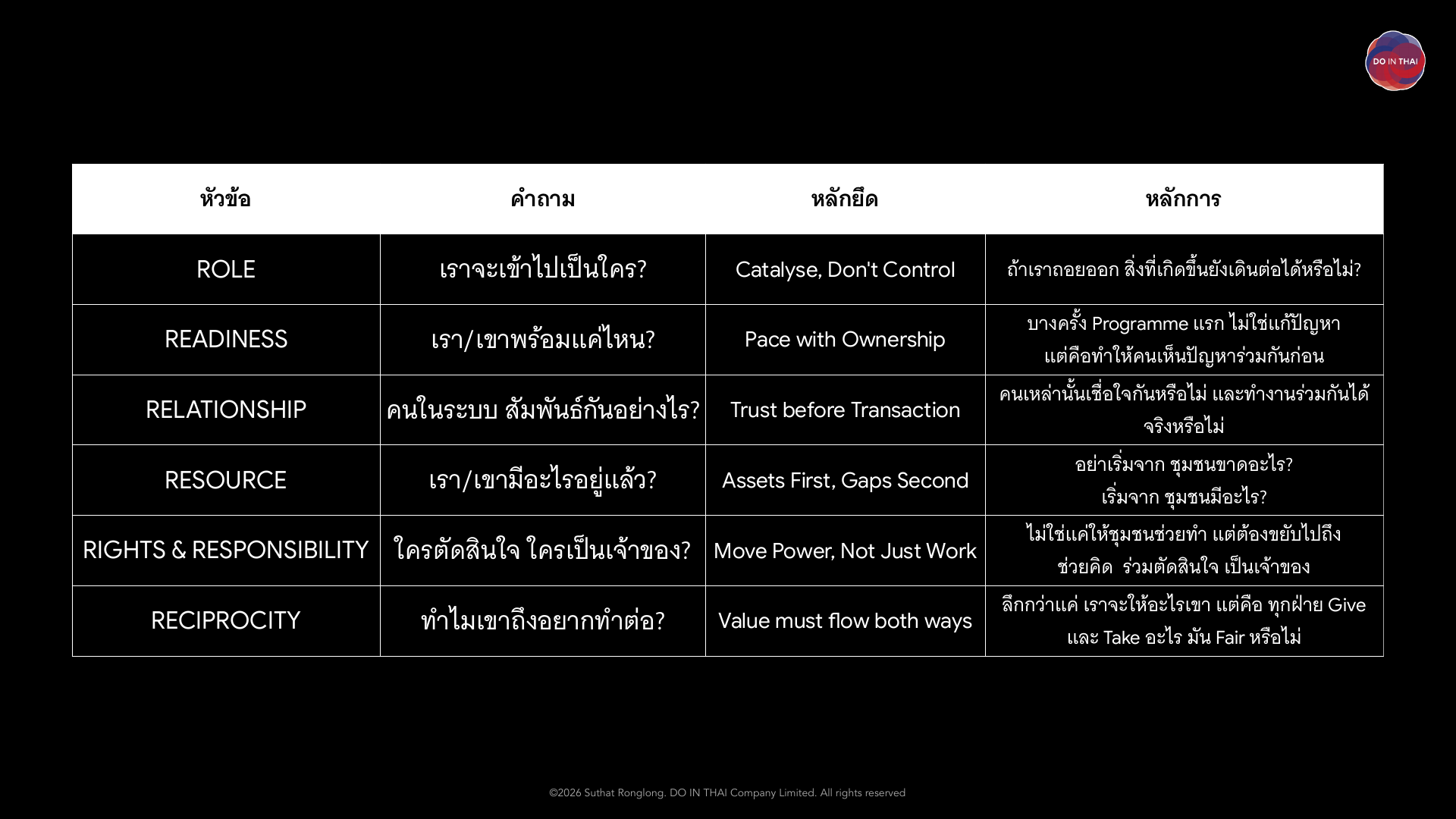
6R: questions to keep returning to as the work unfolds. View full-size image
6P helps us see what we will build together. 6R asks how we will build it so that the people there can truly own it. These questions need to stay with us along the way. People change, circumstances change, and something we thought was ready may need another conversation.
How much do we need to do ourselves?
I want to stay with the question of roles a little longer. People doing community work do not always have to be the ones who think, build, teach and solve. Look closely at what the work needs from us at that moment. Sometimes the most useful thing we can do is bring two groups together, then sit and listen until they have finished talking.
If nobody can run a system yet, we may need to be the Operator and do the work first, while planning how to pass it on. If people know what they want but cannot yet build it themselves, we may act as a Developer, building it with them. And if the existing approach really cannot take them further, we can take on the Innovator role and try something new together, paying attention to how local people will be able to use it afterwards.
In many places, someone is already doing the work. An Accelerator helps that work go further; the people who started it should be able to continue with it. A Catalyst is useful when there is potential but things have not begun to move: help people have a go, until they find the momentum to carry on themselves. If we have to come back and get things started every time, we need to look again at what is still missing.
Where people are working separately, we can be a Convener, making room for them to exchange ideas. Or a Connector / Broker, bringing people, knowledge, money and opportunities within reach of one another. We have to be careful here. After all that connecting, does everything end up having to go through us? The people we introduce should be able to contact one another and work together on their own.
If people want to do the work but need the skills, we can be a Capability Builder / Coach, helping them learn both to do it and to teach others. If they already know how, but lack authority, information or access to funding, we may need to be an Enabler and help clear the way. Once local people can lead, the Steward / Advisor stays available to support the quality of the work. That also means accepting their decisions, including the ones we would not have made ourselves.
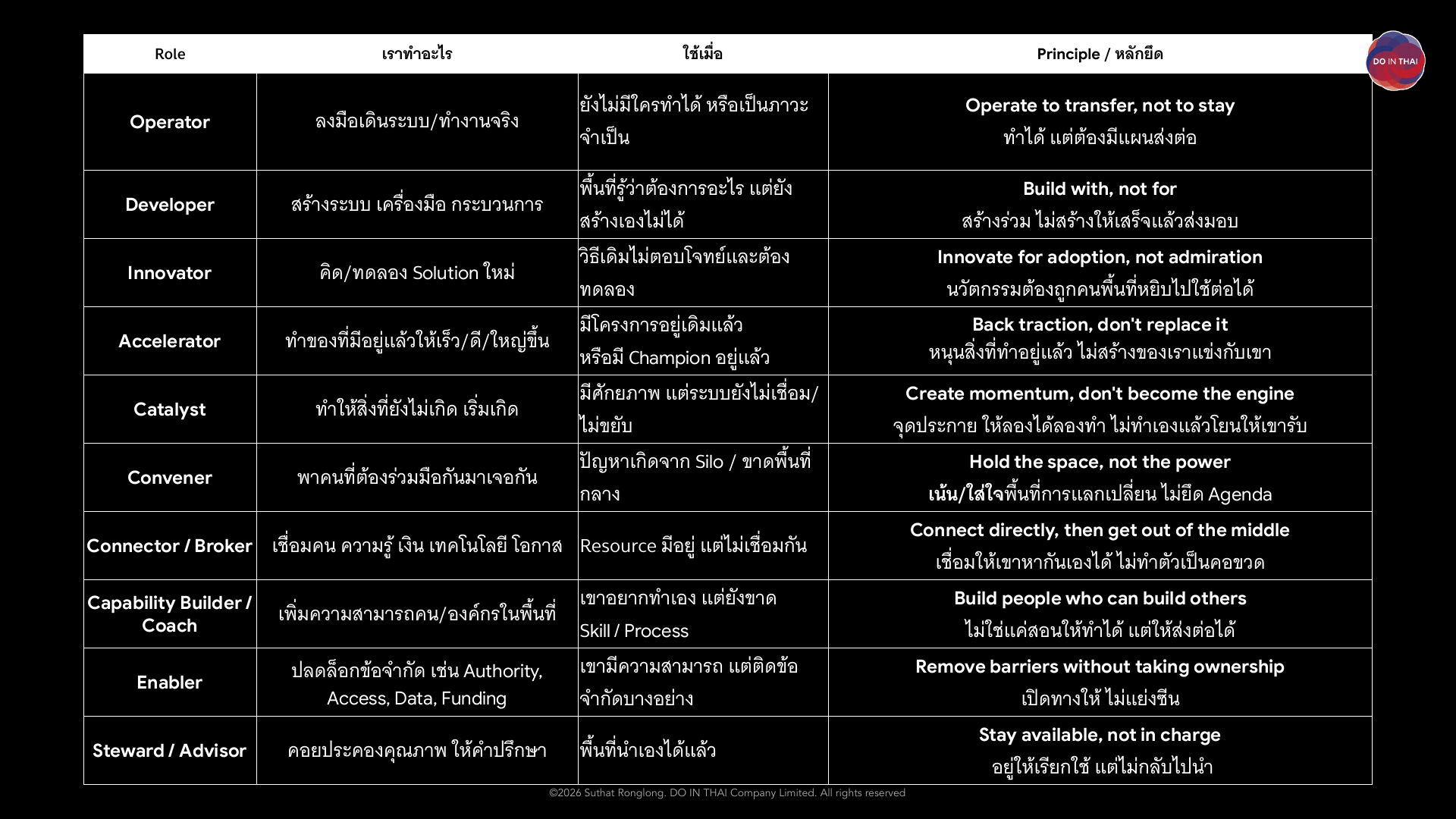
Choose the role that fits what people need at that point in the work. View full-size image
There are a lot of names here. But they all bring us back to the same question: how willing are we to change our own role? To go from doing everything to helping with a few things, as other people gradually become able to do them without waiting for us?
Seeing someone do things for themselves ought to make us happy. We still need to be honest about our own feelings, though. When the day comes that nobody needs to call us about every decision, are we really ready for it?
Looking again at water
Take water in Mae Kha, Fang district, Chiang Mai, as an example for designing a programme. Start with drinking and household water shortages in the dry season, water quality and the shared management of resources. The first aim is for the community to have enough clean water and to manage it consistently. That is something we would want to see happen.
Bring the questions about empowerment into it, and we begin asking more precisely: who in the community will understand the water situation? Who will use that information to make decisions? Who sets the rules, and who follows up? The aim now extends to the community's ability to understand its own situation, decide together, act and learn from the results for itself.
Once we think this way, the work of teachers, students and others coming in to help begins to change too. A water survey can bring together things that people each know separately, so they can see them together. Working with data can help knowledge travel from one person to another. A discussion needs to make it possible for the people involved to talk about difficult things, until they can use these ways of working themselves.
The community then has room to analyse the problem, choose what comes first, agree on shared rules, try something small and look at the results together. If it is not good enough yet, adjust and try again. This cycle matters. Water problems do not stop changing when we finish our report. The people who remain need information, the ability to act and the right to keep adapting how they work.
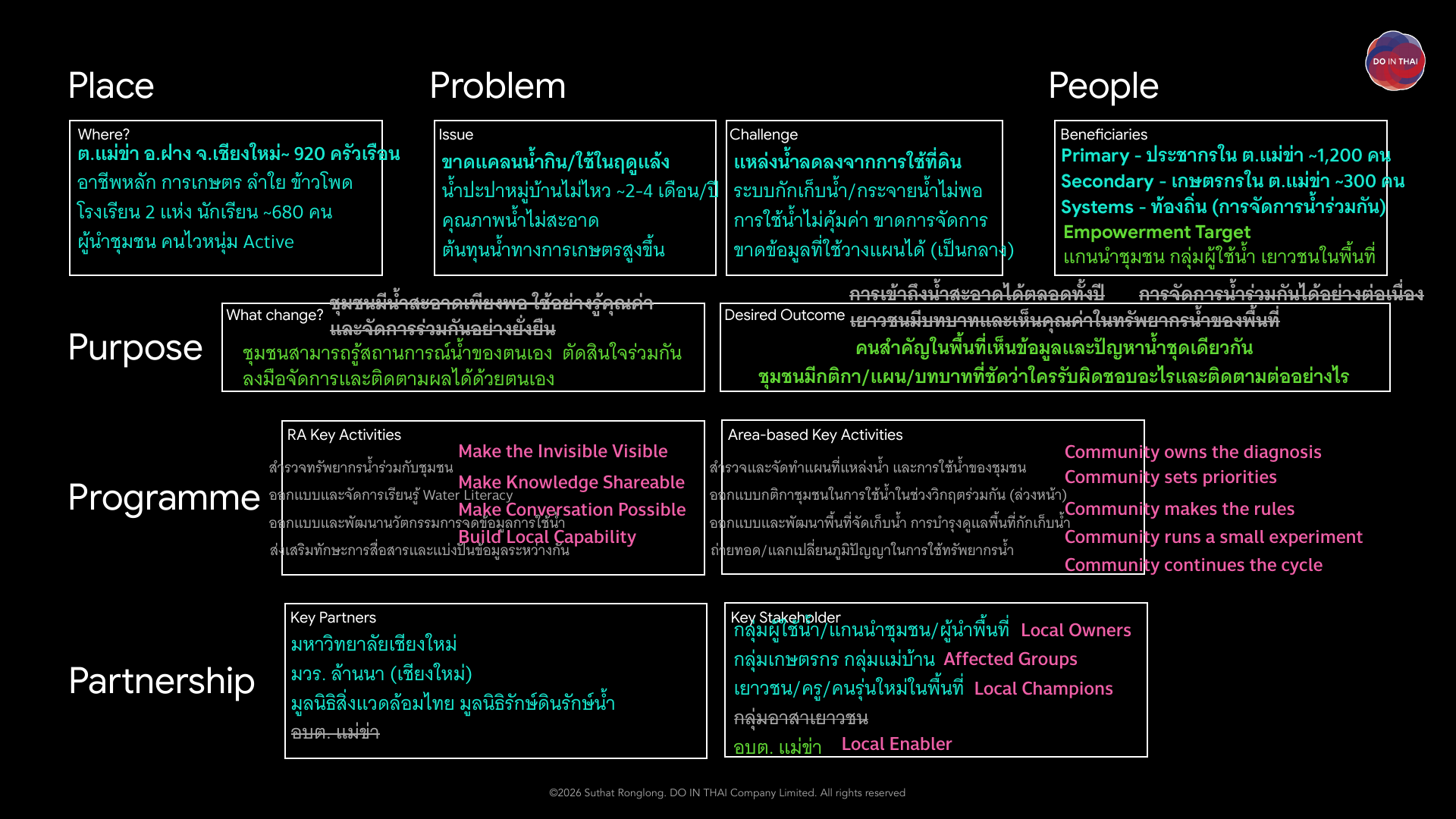
Reworking a water programme so the community owns the decisions. View full-size image
We also need to look more closely at the people involved. Who owns the work locally? Who is affected by the decisions? Who has the energy to move things forward? Who can help remove obstacles? They do not all have the same role, and we should not expect everyone to take part for the same reason.
For teachers and students, this way of working may not end with something they can control in every detail. There will be things to wait for, things they need to listen to again, and other people's ideas that change the original plan. This is where they get to learn how others think, and see how the knowledge they brought can find a place in people's real lives.
Stepping back, while staying within reach
Stepping back depends on how ready people are. At some stages they will still need us to help do the work. At others they will need someone alongside them. Some things will take longer than planned. What should be clear from the start is how we are helping people gain the ability and the right to manage their own affairs.
If one day they can ask their own questions, bring people together themselves, and find their feet again when something goes wrong, we have good reason to begin stepping back. By then they may do things differently from us. They may choose a method we are less comfortable with, or take the work somewhere we never imagined. Ownership has to leave room for that.
I still believe that the sustainability of development work rests with people who have the energy to keep working for their own place. People who are willing to live with the consequences of their choices, and who have enough companions along the way to help them learn when things do not turn out as they hoped. Our part is to help make those conditions possible, and to recognise when it is time to make a little more room.
Before the next piece of work begins, here is one question to take with you. Think of the day when you are no longer there. What more will the people who stay have in their hands? Knowledge? People they trust? The power to make decisions about their own lives? Enough energy to try again?
As for us, if they still want to turn to us, we can be there when they do. That may be a good enough relationship for both sides to keep going.