
Expectation management: a first lesson in working with people
From what we quietly hope for to what we promise other people: how to separate hopes from commitments, make room for what has not been said, and agree on a way forward while taking responsibility for the consequences.
When we want to do something well, it is easy to assume that the people around us want to see the same thing happen. Sometimes, by the time we realise they do not, the work is already well under way. People have already given their time. And someone is waiting for something we did not even know they were expecting.
My life has included doctoral study, a period working with a NASA lab, and time spent as a Buddhist monk. Looking back at those experiences alongside my social innovation work at DO IN THAI, there is one subject I think we should study seriously before we start applying our knowledge to other people's lives: expectation management.
At school and university, we practise finding answers, completing work and making things better. We get less practice in asking what we become responsible for when something we believe is good gives another person hope. And if we later discover that we cannot do what we had in mind, how do we go back and talk to them?
The more meaning we find in our work, the more this question matters. What we choose to do can affect other people's opportunities, time, money and relationships. They may be waiting for our answer, planning their lives around our promise, or giving something up to make the work we have invited them into possible.
I left this question near the end of Why Design Thinking fails. A team may believe it is running an experiment. A funder may expect something ready to use. People in the community may understand that we have promised to solve their problem. Everyone is working on the same project, but each is waiting for something different.
That is why I think this belongs in a 101 course: a first lesson for anyone whose work will affect other people's lives, even if the work is small and only a few people are involved.
What do we hope for, expect and promise?
Take a simple hypothetical example. A team wants to help a community use water data to make decisions. They say they want local people to be able to manage water for themselves. It sounds like a good aim. Everyone nods. But what each person imagines happening next may be very different.
The people building the tools may want to try out a set of sensors. Local people may understand that someone will keep looking after the system. The funder may expect water problems across the whole subdistrict to improve within a year. When everyone sits down to review the work, pride and disappointment may share the same table.
I want to separate three things we often talk about as if they were interchangeable.
A hope is what we want to happen. We want people to have enough water. We want them to be able to make decisions about their own lives. Hope gives the work a direction and a reason to begin.
An expectation is what we think is likely to happen, given the information and conditions we have. In this round, for example, we may expect to learn how consistently we can collect data. But we still need to find out about the power supply, connectivity and the time available to the person looking after the equipment. New information can change what we expect.
A promise is something we have agreed to take responsibility for. Who will install the equipment? Who will pay? Who will come back to review the results? If something breaks, who will take the call? Other people use our promises to make plans, so a promise needs to be clearer than something we would like to do.
Look at the last message you sent to your team, a client or someone in a community. When we write, “We'll look into it,” we may mean that we need to find out more first. They may understand that someone has taken responsibility. So they stop looking for other options and wait for us.
We may never have intended to promise that much. But if our words left room for that understanding, we should go back and make things clear. Saying afterwards, “I never promised,” may be technically correct. It does not give them back the time they spent waiting. We are entitled to say how much responsibility we can take. The sooner we say it, the more chance they have to choose another way.
The same flag, a different route
When people hear about managing expectations, they may think of promising less so they can deliver more and keep everyone happy. Or of telling themselves not to hope for too much, so they will not be too disappointed.
In my work, I would like to begin by being honest about both what we want to see and what is actually happening. We can give ourselves room to dream. At the same time, we need to be able to say where we are now, what we have available, and what conditions are still missing.
Peter Senge describes creative tension as the gap we see when we hold a vision of what we want alongside current reality. It gives us something to work on. If we escape the discomfort by steadily lowering our aspirations, or by pretending today's limits do not exist, we lose an opportunity to find a way to change that reality.1
I picture a flag on a mountaintop. We may still want to reach it, but the path we expected to take may have collapsed. Someone in the group may no longer be able to keep the same pace. We may need to rest, find help or take a longer route. Acknowledging these things lets us plan our next steps. Saying that everything is still the same, just to keep people's spirits up, may leave everyone stuck at the broken path.
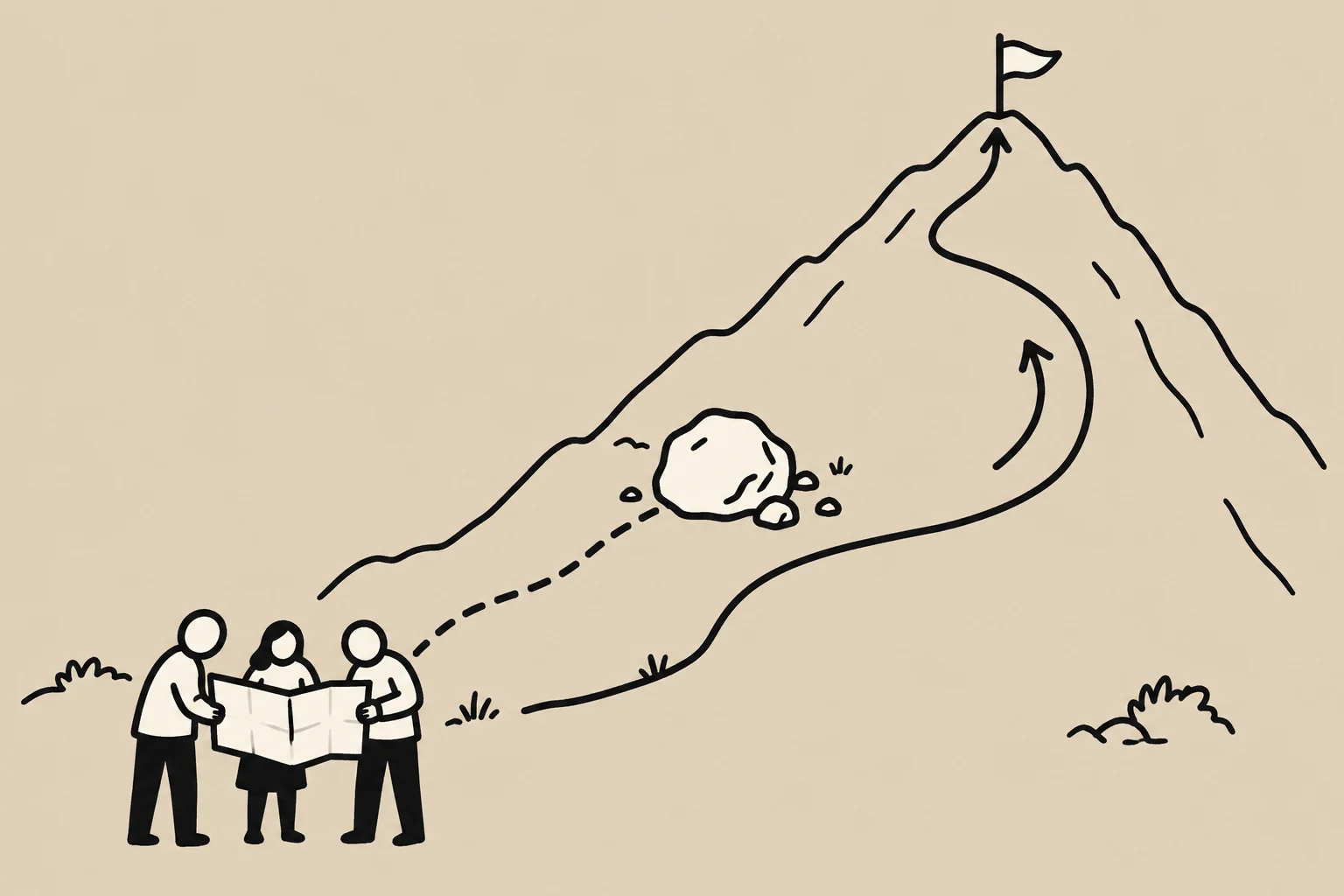
The flag marks where we hope to go. The route must respond to what we find and what the people travelling together can manage. View full-size image
If the aim is for a community to make decisions about water, abandoning an app that nobody finds convenient and returning to a board and conversations they can organise themselves may bring us closer to that aim. We need to notice whether we are protecting the purpose of the work or the form we wanted it to take.
The flag itself must be open to reconsideration too. Whose flag is it? Do the people who will live with the consequences still want to go there? If we discover that our goal creates a burden for them, we need to look at that goal together again. Our persistence cannot stand in for someone else's consent.
Before trying to read their minds, look at our own
Some expectations have been with us so long that we barely notice them. We want to do good work. We want to be useful. We want people to believe in our ideas, or to recognise the years of effort behind them. One person can feel all of these things at once.
Problems begin when we cannot see which of our own needs are shaping someone else's life. We say we want people to be able to do things themselves, then feel unhappy when they choose a different approach. We say we want the project to continue, then feel that we no longer matter when they stop needing to call us.
When I reflect on this, I think of the distinctions between kinds of desire in Buddhist teaching. P. A. Payutto explains chanda, in this context, as the wish for things to be good and to flourish, distinct from wanting things that gratify us.2 I bring that back to a simple question for myself: do I want their lives to improve, or do I want the feeling of being the person who improved their lives?
We do not have to make ourselves look good in every answer. People have mixed feelings. But noticing them gives us more room to decide what to do: listen again, let someone else lead, or admit that we are tired and need encouragement, without making the people we help responsible for meeting that need.
There is a question I find useful to return to. If this work went well and my name appeared nowhere in it, would I still want it to happen? If I hesitate today, what am I holding on to?
The question is there to help us know ourselves a little better. We can answer it honestly only if we do not immediately use the answer to judge whether we are a good or bad person.
How do we find out what has not been said?
The people working with us have expectations too. Some they have expressed. Some they assume we already understand. Others they do not know how to bring up.
Denise Rousseau uses the term psychological contract to describe an individual's beliefs about the obligations between themselves and an organisation.3 It helps us see that alongside written agreements, there are things each side believes the other has promised. Not every expectation is an obligation. But once someone believes “we agreed on this,” not receiving it means more than simply not getting what they wanted.
Applied to community work, this prompts us to ask what people think we will do for them, and what they think we are asking of them, from the moment we begin talking. Repeated interviews, photographs, notes and assurances that the information will inform further work may already leave people waiting for something, even while the team still calls it data collection.
An iceberg can help us separate these things out. Above the water is what has been said. Below it, try writing down three more things: what people assume is understood, what they fear losing, and what they hope for but hesitate to ask.
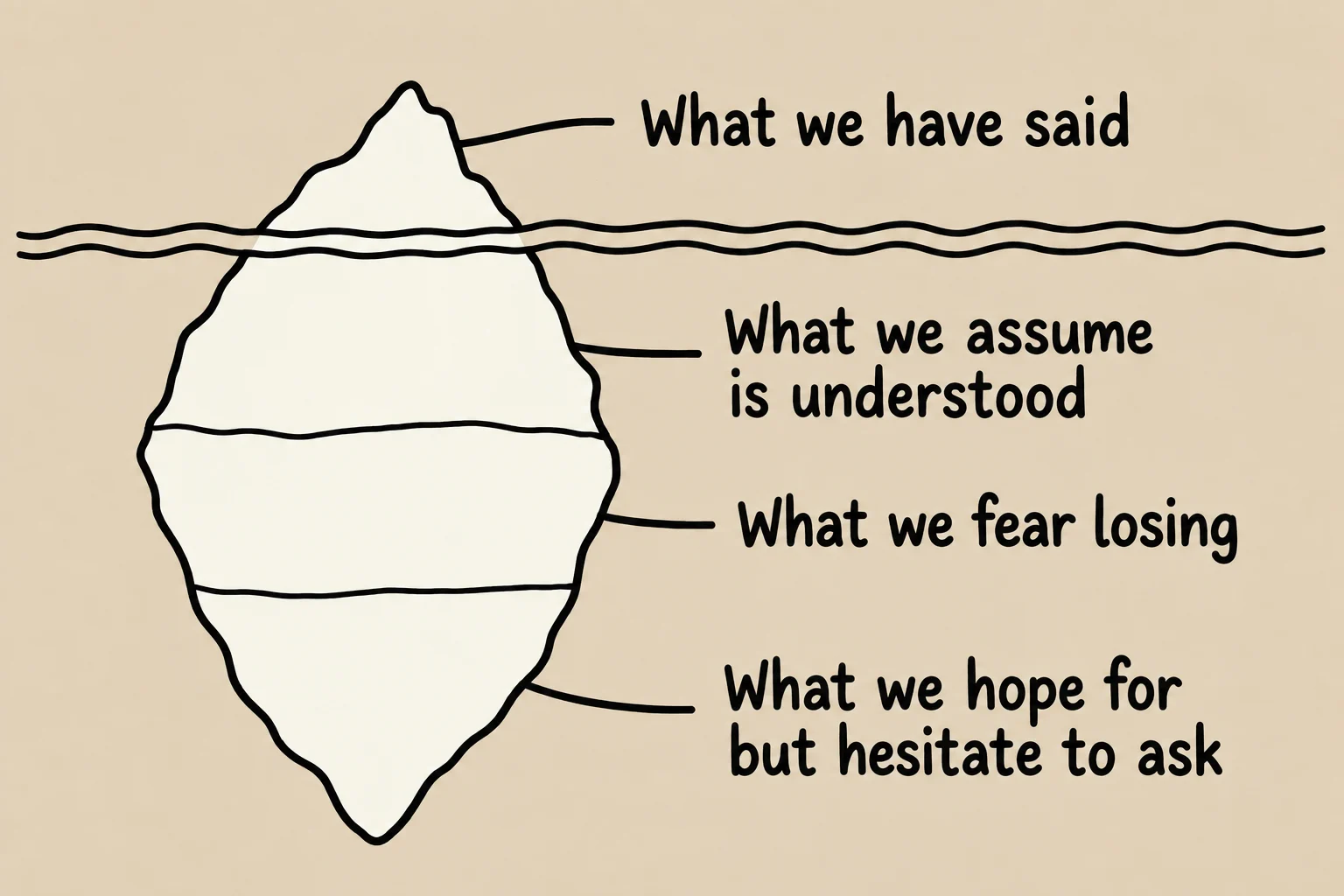
Use this picture to help ask questions, rather than to guess what a quiet person is thinking. View full-size image
In the water example, the person looking after the equipment may simply say, “Yes, I can help.” There may be conditions we do not yet know about. It could be dark by the time they get home from work. They may share a phone with their family. They may worry that they will have to pay if the equipment breaks. Any of these might be true, or none of them. We need to make room for them to tell us, rather than fill in every layer of the picture on their behalf.
Before a group conversation, each side could briefly write down its expectations separately. Then compare where their understandings differ. For things people are uncomfortable saying in front of others, offer a private conversation or a way to speak through someone they trust. They must also be free not to answer, especially when speaking could affect their relationships or livelihood.
Saying “you can tell us anything” is unlikely to be enough. People will also notice how we responded the last time someone said something difficult. If we rushed to defend ourselves, find someone to blame, or repeat what they told us to others, their answers may get shorter each time.
Amy Edmondson studies psychological safety: a shared belief within a team that people can ask questions, acknowledge mistakes or disagree without fearing humiliation or punishment for speaking up. Her research found an association between this kind of safety and team learning behaviour.4 For me, it raises a question about our work: how willing is the person in front of us to say, “What we planned doesn't work”? And when they say it, what actually changes because we listened?
Who gains, who gives something up, and whose voice is missing?
Even when everyone in the room understands one another, the work still sits within a larger system. There are people who were not at the meeting, existing relationships, and time and income that people need to protect.
In When we step back, who carries on?, I wrote about rights and responsibility. The people we expect to carry on need both the ability and the authority to make decisions. Otherwise, what we hand over may become a burden they had no choice in taking on.
Return to the water data example. If more people can see the information but the same person still makes every decision, others may not feel any more involved. Meanwhile, the person assigned to collect data may lose time they would otherwise spend earning a living. People who do not use a phone may be left outside the flow of information altogether.
Before concluding that everyone benefits, put the names of the people involved on a sheet of paper. Who gains what? Who has to give something up to make this possible? Whose voice is still missing from this page? Leave what we do not know as questions to listen for. Do not fill the gaps with assumptions that people are uninterested or unwilling to change.
When people try a prototype, we also need to pay attention to how we collect feedback. Research by Nicola Dell and colleagues in India found that participants tended to prefer the product they believed the interviewer had developed, even when the other product was identical.5 This does not mean that every Thai person gives answers out of politeness. It does remind us that a person's relationship with the interviewer can become part of the feedback we later use to conclude that our product works.
Instead of only asking whether they like it, we could observe how they actually use it. Where do they need help? When do they leave it unused? Which existing alternatives are still more convenient? We can take encouragement from praise. Deciding whether to continue needs more information than that.
Expectations about time deserve the same care. A month means something different in the life of a research team, a teacher or someone waiting for income from a harvest. When a deadline moves, we need to discuss what that means for them. Moving a box in our schedule does not settle the consequences in their lives.
An agreement that lets us begin, and lets us stop
Once we understand more of what each side expects, we need to turn that understanding into something we can use to make decisions together. Otherwise, we may have a wonderful conversation on the first day, then all go back to acting on our original assumptions.
There is useful evidence from research on realistic job previews, which show people both the attractions and the limitations of a job. A meta-analysis by Earnest and colleagues found that perceived organisational honesty was an important mechanism linking these previews to lower voluntary turnover.6 This evidence comes from employment settings. Applying the idea to community work still requires learning from the places where we work. But it gives us a reason to consider what being open about limitations from the start can mean for a relationship.
I would like us to have a short agreement that everyone involved can understand in the same way. Use the language of the people doing the work together. Write it, draw it, or talk it through and repeat back what has been agreed, whichever works for the people there. It should answer these questions.
- What will we do in this round, and who is responsible? In the water example, we might begin by collecting data at one site and finding out who can actually read and use it before expanding. Identify who does the work, who looks after it and what costs will arise.
- What can we not promise yet? We may not have agreed to install equipment across the whole subdistrict or maintain it indefinitely. If something is still only an option, say that it is an option.
- What does nobody know yet, and how will we find out? Is the proposed site suitable? Which decisions could the data help with? How will we test this, and what will we look at to decide whether to continue?
- If it becomes too much, how can we say so, stop or change direction? Who can people contact? Is there a way to talk privately? If the person looking after the equipment steps away, what happens to the remaining work and equipment? Who is responsible for the costs already agreed?
- When will we review things together? Set aside time to hear what happened and revise the plan before expanding. Include a conversation about how much support we can offer after the trial and what local people actually want to take on.
An agreement like this cannot make everything certain. It can help us see the conditions under which we are working together, and give someone a chance to say now that those conditions are more than they can manage.
Before starting, we could add another question: imagine some time has passed and this work can no longer continue. What might have caused that? Let each person think before hearing the others' answers. This is a premortem approach to risk.7 Then bring the question closer to people's lives: who might have to give something up because they want to keep their promise to us?
What we learn should help us revise the agreement so it is workable. For example, if the person looking after the equipment needs more time away from paid work than agreed, we will pause the trial and revisit staffing and costs first. We should not leave them pushing through because they believe it is their responsibility alone.
An “if this happens, we will do this” plan connects to implementation intentions: specifying a situation and a response in advance to help turn an intention into action.8 In shared work, we also need to check that the people named in the plan have agreed, and have the authority and resources to act. Otherwise, it becomes another promise that only makes the person writing it feel good.
When we learn more, we need to talk again
An agreement made on the first day rests on what we know that day. As we work and learn more, some expectations will change. Our responsibility is to bring what we have learned back to the people involved in time for them to use it in their decisions.
If we realise we cannot finish on time, we should say so when we see the problem. Be clear about what has already happened, what we are still assessing, who is affected and what options remain. Where we have made a mistake, take responsibility for it directly. Calling something an experiment or a learning process does not erase an earlier promise.
Some things need to be explained gradually. We need time to listen to where people feel disappointed or angry, and what difficulties they face. Sharing information in a way people can absorb and withholding important information because we fear their reaction have very different consequences for their ability to decide. We should help them know enough to choose before that opportunity is lost.
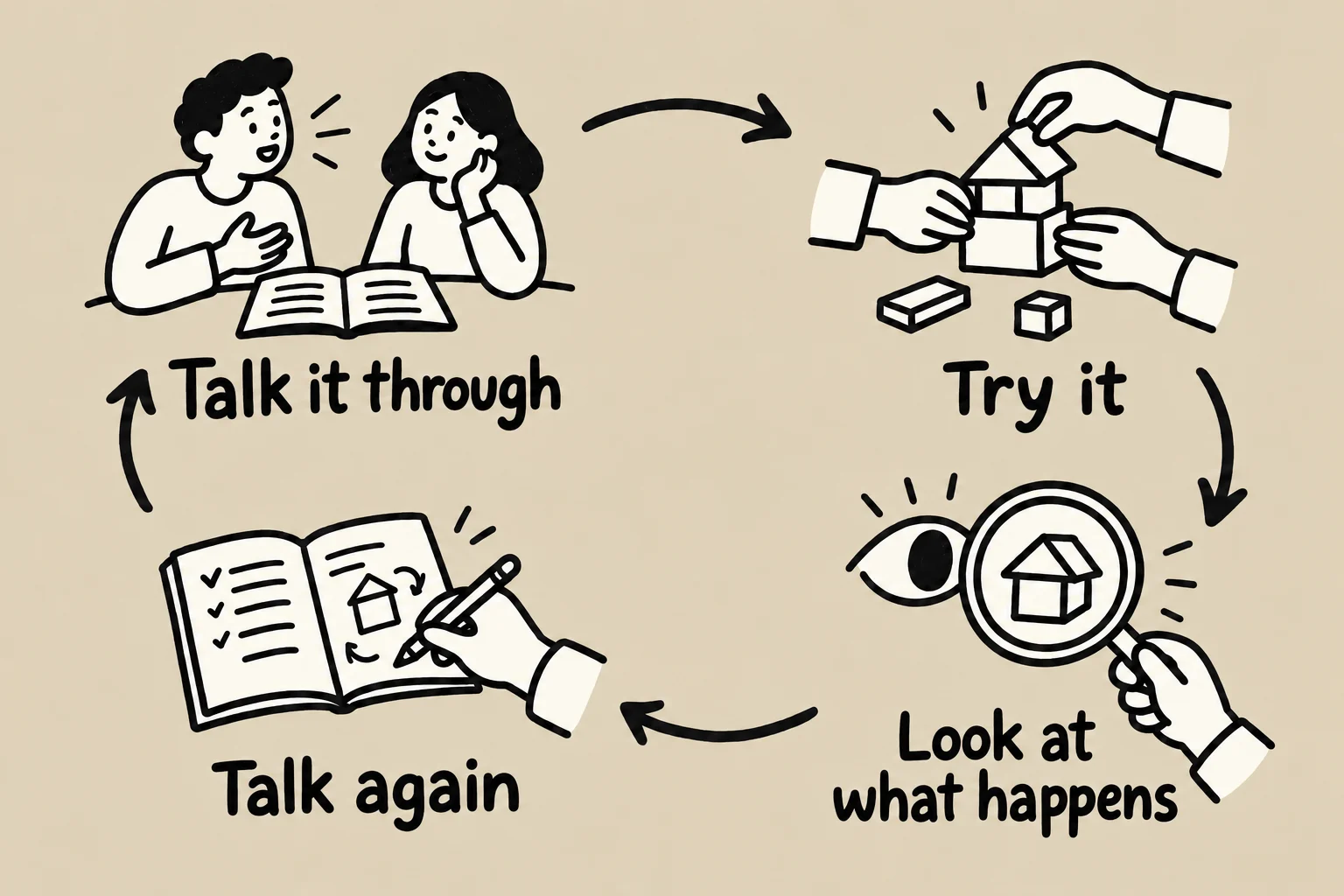
What we find during the work needs to change both how we work and what we agree to. View full-size image
This connects directly to Design Thinking. When we go to listen, we need to explain why we are there and how we will follow up. When proposing an idea, we need to make clear what is still only an idea. During testing, people must be able to tell us that it does not fit their lives. Once we learn that, the team and the funder need to be willing to reconsider the plan too.
If we have already promised success, but tell only the people testing the idea that it is an experiment, the person in between is left carrying two sets of expectations alone. A clear account of the work needs to reach everyone whose decisions depend on it.
This cycle of talking, trying, looking at the results and talking again may seem slow. But it can help us notice different understandings before the handover day, when we discover that someone has spent all this time waiting for something we never intended to do.
What can we choose?
Even after clear conversations and careful work, the outcome may still fall short of what we hoped for. People can change their minds. Conditions can change. Some things lie beyond the authority of everyone in the room.
I find it helpful to separate what is weighing on me into three parts: where I can choose my own actions, where I need to reach an agreement with others, and where I cannot make things happen as I wish.
We can choose whether to give accurate information, whether to promise more than we can manage, whether to listen to the end or rush to answer, and how to return and take responsibility when we make a mistake. These choices take practice. We need to arrange our surroundings so that we can act on them. Knowing the principle does not make it easy.
Whether someone else works with us, trusts us or wants to use what we build involves their decisions too. We can improve the conditions and explain ourselves more clearly. The final answer is theirs to give.
Then there is the weather, the timing of people's lives, events we did not foresee, and conditions within a system that we cannot change alone. We can prepare, or join others to change some of those conditions. We cannot order every factor to fall into place according to our schedule.
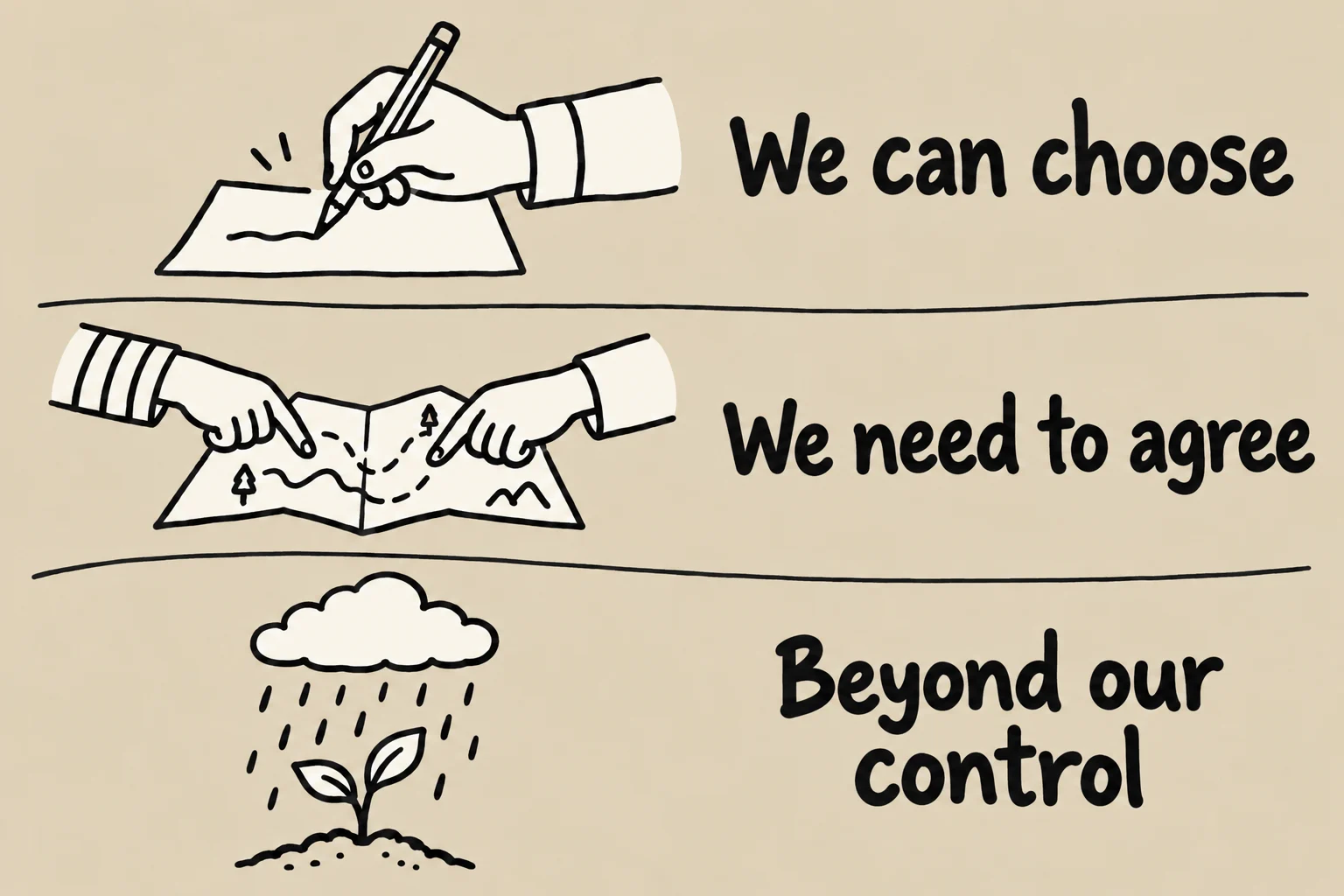
Make the distinction so we know where to put our effort, who to talk to and what to prepare for. View full-size image
For me, accepting outcomes we cannot control has to go together with taking responsibility for what we do. If we give someone wrong information and they suffer as a result, telling them to let go would be much too easy for us. We need to correct the information, look at the harm and take adequate responsibility for our part in it.
In explaining equanimity, P. A. Payutto distinguishes a calm mind grounded in understanding from simply being indifferent to what is happening.9 I take this as a reminder to do our part well while recognising that other causes and conditions are also at work. Training our minds must not become an excuse to neglect the lives affected by our actions.
Before the next piece of work
To try this out, start with one thing you are working on. Write down what you want to happen, what reason you currently have to expect it to happen, and what you have already promised to whom. Then choose one person involved and have a conversation. Listen for whether their understanding really matches yours.
If you discover that you have been imagining different things, there is still something you can do. You may need to change the timing, redistribute the work, admit what you do not know, or give the other person back the choice of whether to continue together. What you learn in that conversation should be able to change something about how you work.
Expectations cannot be settled in one conversation. Our lives, and the lives around us, keep changing. This 101 course is probably one we need to take again and again: when we begin, while the work is still finding its way, and when it is time for us to start stepping back.
For those of us trying to do something small and meaningful with the resources we have, I think this is a place to begin. Know what we hope for. Be honest about what we can do. Let the people who will live with the consequences choose their own way too.
We may not yet know how far we can go. But before setting off, we should at least hear where the people we have invited want to go, and what they need to take care of in their lives along the way.
References
-
Peter Senge (2003). Creating Desired Futures in a Global Economy. Reflections, 5(1). Discusses creative tension between vision and current reality, building on Robert Fritz's work. The flag and route in this article are an analogy for thinking through the idea.
-
P. A. Payutto. Wholesome aspiration is chanda (Thai). This article draws on chanda as explained in the context of a wish for what is good. The questions about motivation are an application for personal reflection.
-
Denise M. Rousseau (1989). Psychological and implied contracts in organizations. Employee Responsibilities and Rights Journal, 2, 121–139. The original research concerns beliefs about obligations between individuals and organisations. Its use here to consider community work is an application of the concept.
-
Amy Edmondson (1999). Psychological Safety and Learning Behavior in Work Teams. Administrative Science Quarterly, 44(2), 350–383. Studied work teams in a manufacturing company. It did not test the iceberg exercise described in this article.
-
Nicola Dell and colleagues (2012). “Yours is better!” Participant Response Bias in HCI. CHI 2012. Studied response bias in Bangalore, India. Its findings should not be generalised to every participant or culture.
-
David R. Earnest, David G. Allen and Ronald S. Landis (2011). Mechanisms Linking Realistic Job Previews with Turnover: A Meta-Analytic Path Analysis. Personnel Psychology, 64(4), 865–897. Examines mechanisms in employment settings. It does not directly establish the effectiveness of the five-part agreement in community work.
-
Gary Klein (2007). Performing a Project Premortem. The question about who might have to give something up extends the exercise in line with this article's approach.
-
Peter M. Gollwitzer and Paschal Sheeran. Implementation Intentions. The researchers explain plans that specify what action to take if a particular situation arises, and the related evidence. The tools adapted in this article still need to be assessed in the contexts where they are used.
-
P. A. Payutto. Threats to Buddhism (Thai). The explanation of equanimity distinguishes composure based on understanding from indifference and neglect of responsibility.