
Why does Design Thinking fail?
We followed every step, so why is the problem still there? A closer look at our goals, our understanding of people, and whether we leave enough time to experiment, learn and try again.
Think of a Design Thinking workshop. We interview people, cover a wall with sticky notes, come up with ideas together, make a prototype and present it to the group. Every step done. We go home feeling we've learned quite a lot. But when we try to use it in our actual work, we don't know where to begin. Or we do begin, and still can't solve the problem we set out to address.
Did we get a step wrong somewhere? Perhaps we did. But I want us to look at something else too. As we went through all those steps, what did we come to understand better? Do we understand the people we are doing the work for any better? Do we see the problem differently from when we started? And after finding out that our first prototype didn't work, how much chance did we have to go back and keep working on it?
If all our time went into completing the process, we may not have practised the hardest part yet. Staying with something we don't understand, accepting that our first idea may be wrong, and gradually finding a way that works in people's actual lives.
What do we actually want to happen?
When I talk about innovation, I am interested in creating positive change through new ways of doing things, without taking our own point of view as the starting point. Something we are excited to build may not matter much to the people who have to use it. And something that seems ordinary to us may make a big difference in someone else's life.
Before deciding what to build, we need to talk about whose life we want to improve, and what part of it. Do they want it to improve in the same way we do? If we succeed, what will we see that is different from today? Those answers help us choose what to do when we have ideas we like, limits we have to accept, and too little time to do everything.
I think of this as a north-star goal, something to come back to when we have a decision to make. If we want people to get where they are going on time, making the wait for a lift more enjoyable may not solve their problem. But if what makes it difficult is standing there without knowing how much longer they have to wait, we have more options than simply making the lift faster.
The goal needs to be clear enough for us to check whether what we do actually helps people. The way we get there needs room to change. If we agreed from the start that we would deliver an app, it may be hard to accept what we hear when we go and listen, even if people tell us they don't need one. Our budget, our plans and our promises are already tied to the thing we wanted to build.

Start with the change we want to see in people's lives, then find a way to get there. View full-size image
Is the lift slow, or are people bored with waiting?
Let's stay with the lift for a little longer. If someone says it is slow, we may immediately start thinking about how to speed it up. Could we add another lift? Change the control system? But before spending money on that, have we stood there and waited with them? Have we listened to when the wait is difficult, and what it makes them miss in their day?
One person may be rushing to work. Another gets sore legs from standing too long. Someone else is simply bored with nothing to do while they wait. They all say the lift is slow, but what would help each of them may be quite different. If we use our own experience to answer for everyone, we may only solve the problem for people whose lives are like ours.
Asking whether the lift is slow or people are bored with waiting is an example of Problem Reframing. We come back to the problem from another angle, so we can see options we missed at first. If the difficulty is not knowing how much longer the wait will be, we might try giving people waiting-time information. If it is standing too long, we need to think about somewhere to sit. And if the lift really cannot carry enough people, we still have to address its capacity and the way it operates.
We need to be careful here too. Reframing a problem doesn't automatically mean we now understand it correctly. We may like the new problem because it is easier to solve, or because it makes an idea we already have look more useful. Boredom, uncertainty, being in a hurry: we still need to go back and listen to and observe the people who actually use the lift.
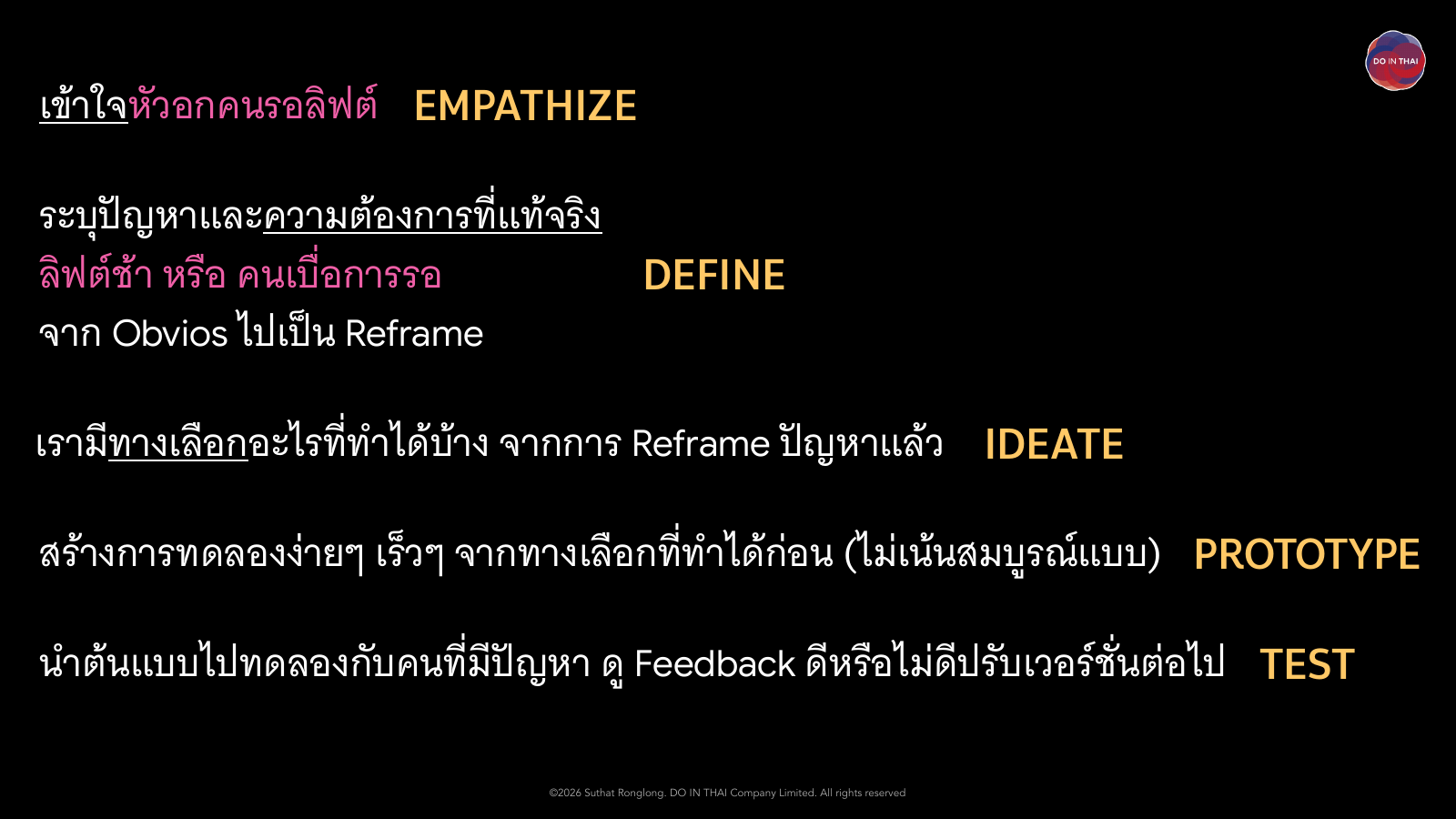
Try looking at the problem from another angle, then take the options we find back to people and test them. View full-size image
I think this is where it gets difficult. We need the courage to see things differently from how we understood them before. We also have to let what we find change our minds. If we change the words on the page but still only listen to things that support our original answer, we haven't gone very far.
Understanding people without rushing to think for them
Another example is traffic outside a school. We see a lot of cars and want to organise them, add entrances and exits, or move the drop-off point. Ask why everyone has to arrive at the same time, and school starting times come into view. Ask why parents have to drive their children themselves, and we may find questions about routes, safety, trust and each family's daily schedule.
Suppose we think there would be fewer cars if children could travel on their own. But their parents aren't yet sure they would be safe. Simply telling them to change how they travel probably won't be enough. We need to understand what worries them, where no one is looking after things yet, and what would let them make a different choice. Some families may have other reasons. We need to keep listening, instead of deciding they are all unwilling to change.
Empathy has to reach into the details of people's lives. When we ask ourselves what we would do in their place, we may still be giving them our knowledge, money, time and confidence. Try listening first to why they make those choices, given the lives they actually have.
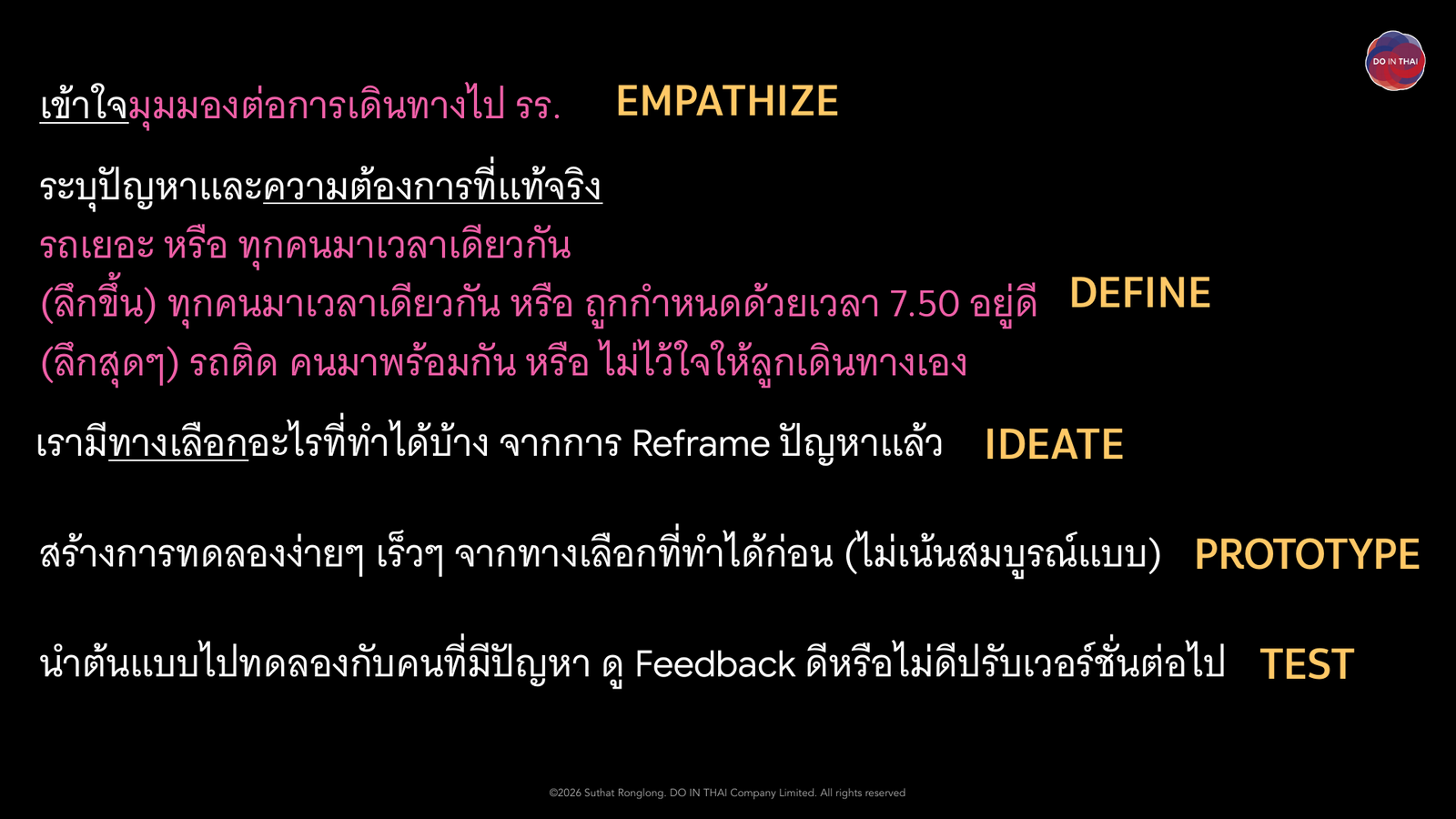
Each question gives us more to understand. We still need to hear from children and parents about what fits their lives. View full-size image
This is why I also see Design Thinking as a Soft Skill. We need practice in listening without immediately arguing back, asking about things we don't understand, working with people who disagree with us, and admitting what we don't yet know. Being good at filling in a worksheet doesn't mean we become good at these things along with it.
The d.school has also written about moving from teaching people to follow a process towards developing their abilities. Living with uncertainty, learning from others and experimenting all take time and practice.1 Seen this way, we may judge what we get from a workshop differently. Listening to someone until they finish, even once, or noticing where we jumped to a conclusion can already be a useful beginning. But we still need to keep practising in our work and our lives.
We can keep working without knowing the answer yet
At school, we get used to problems with an answer waiting for us. When we start working, we may carry that habit with us: wanting to know quickly which way is right, so we can put our effort into getting it done. Uncertainty can make it feel as though the work isn't moving. Yet sometimes we need time to work out whose problem we are solving and whether we understand it correctly.
If we choose an answer too early, the other options barely get a chance. With the lift, we might decide straight away to build an information display because our team knows how to make one. We haven't yet looked at whether changing the queue or the waiting area would help more. The more work we put into it, the harder it becomes to accept that we should try something else.
I would like us to have some time to think through several possibilities together without immediately judging every idea. Then we can choose what to try, based on our goal and the limits we have. IDEO describes this as having both a time for creating choices and a time for making choices. We can return to both as we learn more.2
Not rushing to find the one right answer doesn't mean we can come up with anything and leave it at that. We still have to decide. The decision is what to try, given what we know now, so that we can learn more, and what result would make us change our minds.
After the test, did we get to keep going?
Suppose we want to know whether seeing the waiting time would help people waiting for the lift. We might begin with a simple way to give them an approximate wait, before building a complete system. Then we can see whether they understand the information, what decisions it helps them make, and what is still difficult. We need to be clear about what we want to find out. That helps us make a prototype that is enough to explore that question.
When someone says it is awkward to use, we need time to listen to what makes it awkward. If they don't use it at all, we need to look at why. Did they not see it? Not understand it? Not trust the information? Or did we misunderstand what they needed in the first place? What comes back may lead us to change the prototype. It may also take us right back to the problem we chose to work on.
Empathize, Define, Ideate, Prototype and Test are the five steps familiar to people who have learned Design Thinking.3 But in this picture, I want us to notice the dividing line too. Often we understand the five steps above it, go through them once, and stop there, even though the work hasn't achieved what we hoped. The part below the line asks something more of us: have we actually gone down there and done that work?
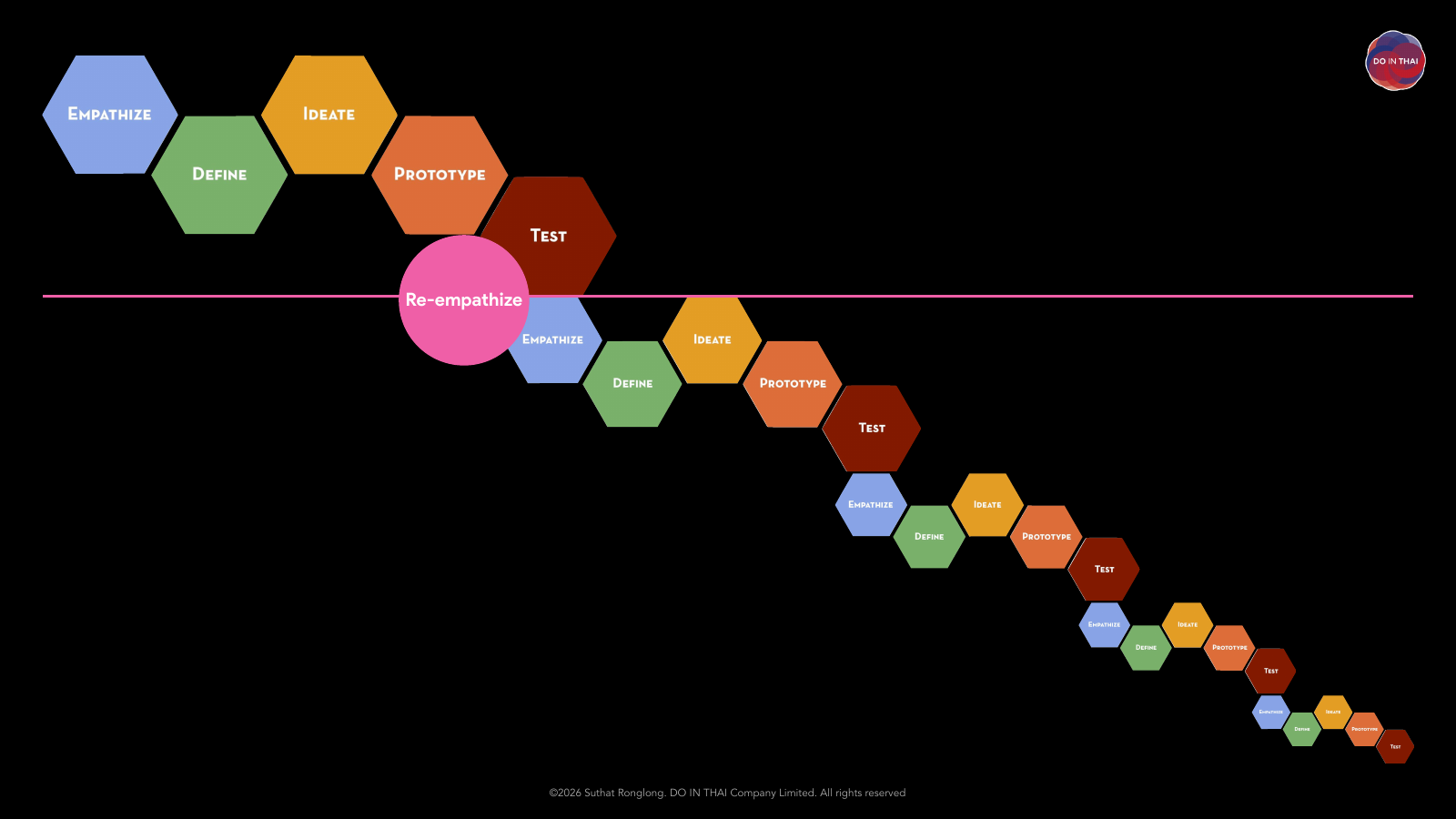
Cross the line and keep working. Experiment and learn, again and again, until it works, without knowing how many more rounds it will take. View full-size image
Once we cross that line, we have to take what we found in the test back to our understanding of people, reconsider the problem, think of other options and try again. Do the work and learn. Learn and go back to doing it again, until what we make actually works for the people we intended to help. Nobody can tell us at the start how many more rounds it will take. Along the way, we may have to change our approach quite a lot. Part of the difficulty is continuing once we know the first round hasn't succeeded.
When we plan the work, we need to leave time to test, look at the results, make changes and try again. If the budget and time only cover making the first prototype, the project may already be over by the time we find out what needs changing. It would be hard to expect something ready for actual use to come out of that.
The people doing the work also need to know how much room they have to get things wrong, who will help when there is a problem, and whether they will get a chance to put it right. If we tell people to be brave with their ideas and try things, then immediately look for someone to blame when the result isn't what we hoped, next time they will probably choose something they are sure will pass. Or make a prototype that looks good enough to avoid too many questions. The courage to experiment needs people who help make it possible too.
But giving ourselves time to try again also means looking at what we learn each time. If the results stay the same and we keep changing small details without reconsidering what we believe, we probably need to stop and talk it through again. Sometimes reaching the goal means letting go of a method we have become attached to, and taking what we learned into another approach.
For me, repeating the work until we succeed means coming back to the goal we agreed on at the start. Are the people we are doing this for actually better off? Can they use what we made in everyday life yet? If not, we need to see what is getting in the way and how to continue. What we learn should help us make better decisions in the next round. Whether we make changes, carry on or stop, we should be able to explain why from what we found.
What about the people waiting for results?
Even if we understand all of this, there are still other people working with us and waiting for the results. The team may understand that we are experimenting. A manager may think something ready to use is on its way. The people helping us test may think we have already promised to solve their problem. When it is time to deliver, everyone ends up disappointed about something different, even though they may all have put everything they could into the work.
Before we begin, we need to talk until we have a shared understanding of what we know, what we still need to try, what we expect to see in this round, and what we will do if it doesn't turn out as expected. One conversation probably won't be enough. What we learn along the way may change the plan. The people involved should be able to understand what is happening and make those decisions together.
For me, the subject we aren't taught in the classroom, and the one that causes us to fail most often in real life, is expectation management. Managing our own expectations and those of the people around us.
References
-
Carissa Carter (2016). Let's Stop Talking About THE Design Process. Stanford d.school. On developing people's abilities and ways of working beyond following a single process.
-
IDEO. The Design Thinking Process. On creating choices, making choices and returning to experimentation and learning throughout the work.
-
Stanford d.school (2018). Design Thinking Bootleg. Tools for five modes: Empathize, Define, Ideate, Prototype and Test.