
Social innovation: what are we changing, and for whom?
Why do we so often think of inventions when we talk about innovation? A look at creating change through new ways of doing things, starting with the people living with a problem before choosing the knowledge, tools and collaboration that might help.
When we ask what innovation means, whether we are talking with teachers, children or people at work, the answers we often hear come back to inventions. Something new. Something that has never existed before. Some people add that it has to be something new that can sell. So when we invite people to try innovating, we start wondering what to build, then hurry off to check whether somebody has already made it.
Coming up with something new is enjoyable. We get to use what we know, try things we do not yet know how to do, and many inventions have done a great deal for people's lives. But if all our attention goes into making something different from everyone else's, we may not have spent much time asking what is difficult for the people we want to help.
Especially in work that starts with people, the newest thing may still be of little use to them. Something that looks quite ordinary to us might help them get to work, have a meal when they need it, or have more say over their own lives. That difference makes me want to return to what we mean by innovation in the first place.
The definition we use affects what we choose to do. If we think the work must end with an invention, we will try to find an invention as our answer. If we start with the change we hope to see in people's lives, there are many more ways to think and act.
What kind of work does our definition lead us towards?
Suppose a teacher asks students to come up with an innovation to address leftover food at school. If the assignment requires something they can bring in and demonstrate, they might think of a smart bin, a machine that sorts food scraps, or an app that records what gets thrown away. These are understandable answers. Each gives them something to show and a way to explain what they have built.
Another group might talk with the people serving lunch and discover that everyone eats a different amount, while every plate gets the same portion. They want to try letting children choose how much to start with, then come back for more if they are still hungry. The work involves talking with the kitchen, changing how food is served, checking whether the queue slows down, and recording what happens to the leftovers. If the trial helps, would we recognise the value of this work in an innovation class too?
I think we should make room for that kind of answer. The students still need creativity, an understanding of people, and the willingness to put their ideas to the test. Those abilities may simply take the form of a shared way of organising lunch, without a single new machine.
Even the OECD and Eurostat's Oslo Manual, a guide to measuring innovation, includes both products and processes that are new or improved enough to differ significantly from what came before, and that have been made available or put into use. Novelty is not limited to thinking of something nobody in the world has ever done.1
The idea that something must be able to sell encourages us to think about users and whether a business can work. In social development, there is more value to consider. Children with enough to eat, people who can access a service, or families who spend less time waiting may not be the people paying us directly. We need to find the resources for the work to continue, while also understanding who actually benefits from it.
Seen this way, the question of definitions is also about who gets a chance to take part. Someone who cannot code or has no access to expensive prototyping equipment can still contribute to innovation through their understanding of something they live with every day, and their ability to bring people together to try a different approach.
Change what, for whom, and in what way?
In thinking about our work at DO IN THAI, I use a short definition:
Innovation = creating change through “new ways of doing things”.
With social innovation, the change we care about is an improvement in people's lives in response to the problems they face, including environmental problems that affect them. We need to understand who we are working with, what they are living with, and what the things we consider good actually mean to them.
The word “ways” gives us more options. It might mean an invention, a service, a way of sharing the work, rules agreed together, or a connection between people who each have something to contribute but cannot yet work together. Technology is among those options. How much of it we use depends on how it helps us reach the change we want to see.
The OECD's account of social innovation also covers changes in concepts, processes, products and ways of organising, with the well-being of people and communities as the goal.2 The short sentence above is how I talk about it with people doing the work. It helps us return to the relationship between what we do and the lives we hope to improve.
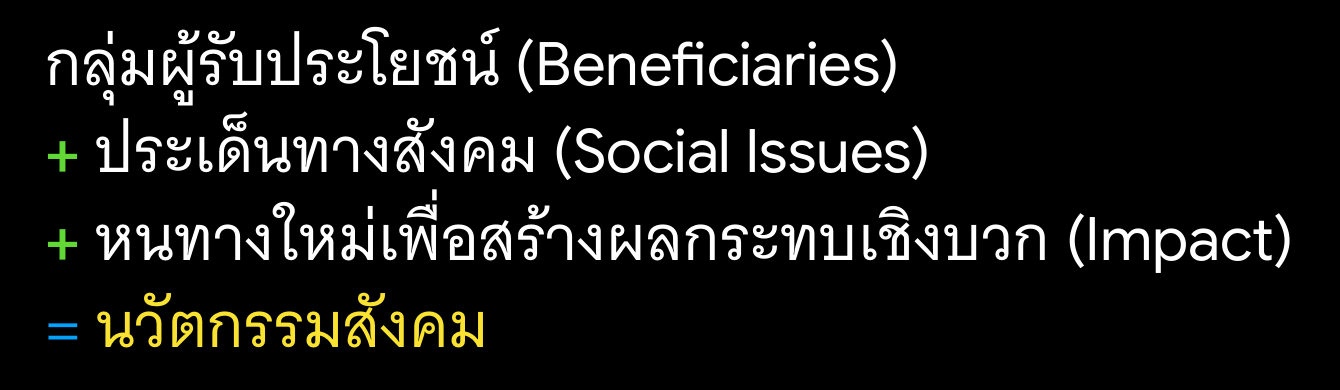
Consider the people, the problem and the way to create change together. Concept diagram by Suthat Ronglong / DO IN THAI. View full-size image
A phrase such as “children who lack opportunities” still tells us very little. Which children? What opportunities? What keeps them out of reach? If the difficulty is not having enough to eat before school, the help needed will be different from that for children who have food but cannot get to school. We can describe both groups with the same phrase. We cannot design all the work around them in exactly the same way.
The word “beneficiaries” in the diagram should therefore lead us to actual people. They should have a say in what matters and what works in their lives. If their only role is to wait for something we have already finished thinking through, we are still making ourselves the starting point, even if we put their names at the centre of the plan.
The food is there. Why does it still not reach people?
Let's stay with food for a while. DO IN THAI's FoodGiving work concerns connecting surplus food from businesses with people who need it. Looking only at the tool, we might describe it as a food-sharing platform. Making that connection happen involves more than matching someone who can give with someone who can receive.
Suppose a restaurant has food it can still share in the evening, but the children we hope will receive it need to eat earlier. Or there is a vehicle to collect it, but nobody to take over storage and distribution when it arrives. Even if everyone opens the app and sees the same information, the food may still miss the meal it was meant for.
The way forward might involve changing when people coordinate, finding a network that can handle the handovers, or starting with food and routes they can realistically manage. We also need to know who checks the food on collection, who decides what can be passed on, and who takes responsibility when something goes wrong. These details belong in the design from the beginning, because the people eating the food live with the consequences of our decisions.
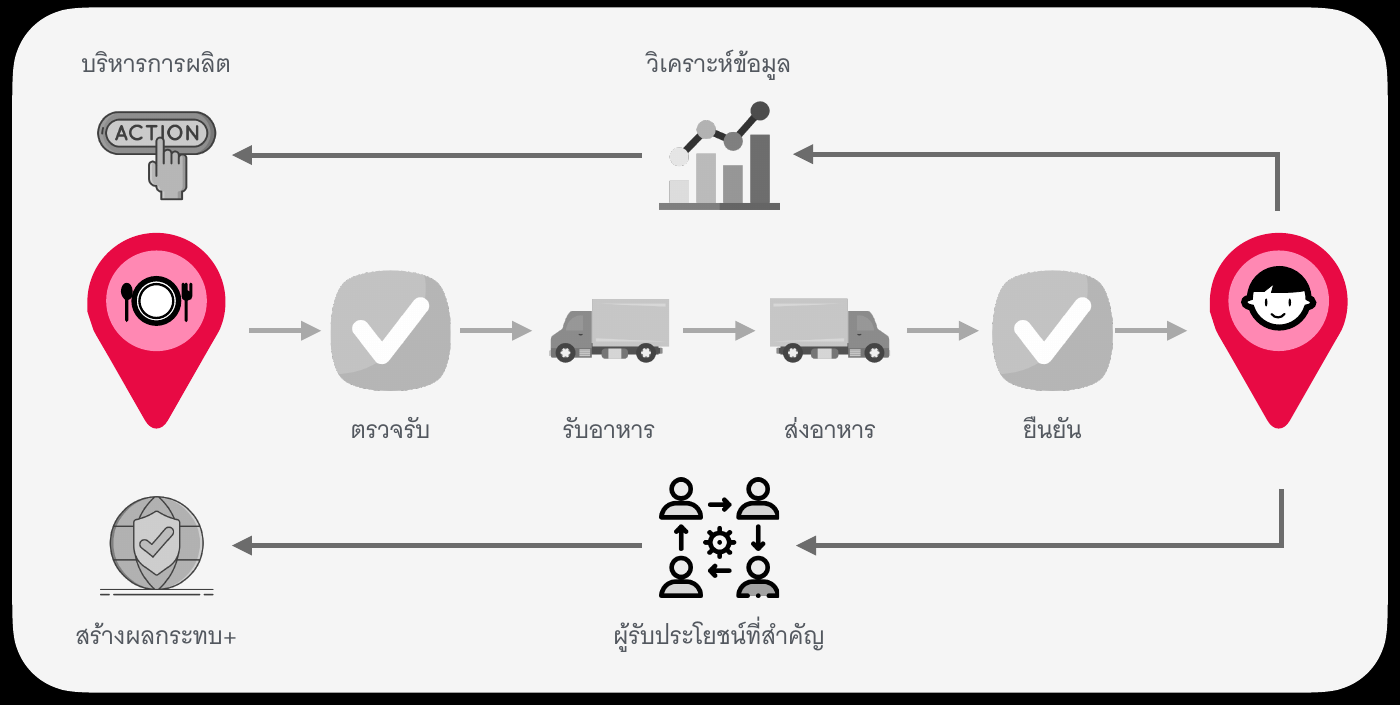
Food needs to reach people. Information needs to come back so people doing the work can adjust how they do it. Concept diagram by Suthat Ronglong / DO IN THAI. View full-size image
The arrow taking information back gives us something else to consider. If a restaurant knows which foods are often left over, how much and when, it may be able to adjust its production. We should be open to a result where less food is left over, even if that means less food passes through the sharing system. If we judge success only by the volume donated, we may miss another kind of improvement.
Looking at connections like these is part of systems thinking. We follow how people, resources, information and rules affect one another. What might be causing the situation in front of us? When we change one part, who else has to adjust?
We do not need to map everything in a city before starting. We do need to see enough to choose where we can act and who we need to talk with. Suppose changing the collection time makes transport easier but leaves people in the community waiting late into the night every day. Their time needs to come back into the decision too. Counting only the time our team saves would hardly be enough.
The novelty may lie in people being able to work together in a way they could not before. An app makes information visible. A vehicle carries food. Local people help us understand what is needed. Agreements help everyone know how far they can rely on one another. We need to look at these parts together to explain what allows the food to reach people.
The work is finished. What do we know about people's lives?
Once we agree that innovation is about creating change, the way we assess the work needs to follow. We have built the system, completed the activities, or brought more people in. These are things worth knowing. There is still some distance between them and an improvement in people's lives.
In the food example, I would like to separate what we are looking at into three levels.
Outputs are what our actions directly produce. We have a coordination system, a network helping deliver food, and a record of how many deliveries reached their destination. This tells us what we have done and how much we have managed to do.
Outcomes are changes for people or in how they do things. Are the children we hoped to help getting enough suitable food more consistently? Are restaurants using the information to plan? Can the people coordinating the work carry on without having to agree on everything again each time? We need to follow how things are used and what happens as a result before we can answer.
Impact concerns broader or lasting effects on people's lives and society. We might hope that having enough food helps children become more ready to learn, or that different groups can keep looking after food needs together over time. These are things to keep following up, alongside the other factors affecting people's lives.
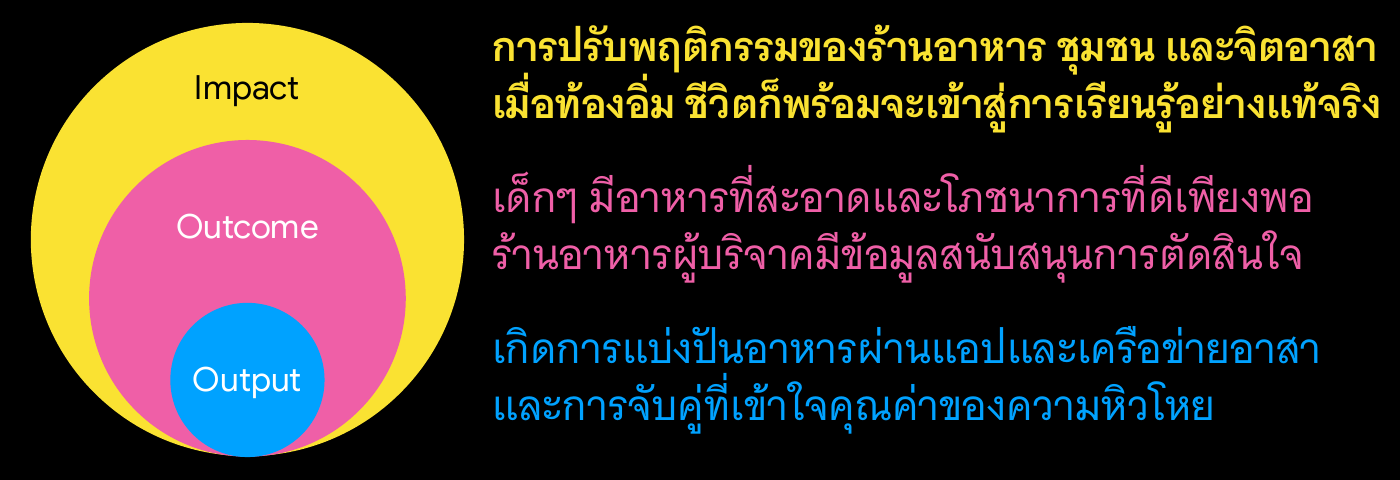
The diagram sets out intended results at several levels. Work in the smaller circle does not establish that the effects in the larger ones have happened. Concept diagram by Suthat Ronglong / DO IN THAI. View full-size image
These three terms help us describe the work according to what we know. If all we know is that the food arrived, that is what we can say for now. To say children are eating better, we need to know which children received it, whether they actually ate it, whether it was suitable, and how consistently this happened. Saying they are learning better because of the project requires more evidence than a photograph of food being handed over.
The people receiving it should also be able to tell us what our numbers miss. The distribution time may not fit their lives. They may be unable to eat some of the food. The way they are expected to receive it may make them feel embarrassed. This information needs to be able to change how we work. Otherwise, we may collect evidence that we delivered the plan without finding out whether the plan was good enough for them.
New ways can use what is already there
At this point, someone might ask: if we use phones people already own, vehicles already on the road, and people already in the community, where is the novelty?
We need to compare it with how things worked before. Food did not get through because people did not know one another's schedules, or nobody was responsible for a handover. How does the new approach change the information, the division of work and the agreements, so that something previously blocked becomes possible? Bringing existing things together to work differently can take as much understanding as building a new tool.
But if everything still works in the same way and we have simply added “innovation” to the project's name, we have not explained what the new way is. And if we only have an idea that we have not tried, we should describe it as an approach we are preparing to test. We still need to do the work to find out whether the results we hope for will follow.
We can learn from something people have already made work elsewhere. We do not have to think it all up again just to make it our own. But we need to understand why it worked, how the conditions in the new place compare, who will look after it, and what needs to change to fit people's lives there.
Choosing to use what is already available also helps us think more clearly about how the work will continue. If an approach is cheap to begin with but requires someone to give up time every day without help, that cost still exists. It has simply moved into their life. We should consider money, time, the knowledge needed, and what the people taking over can manage, as I discussed in When we step back, who carries on?.
Some work can begin with an ordinary approach that everyone involved can try and adjust themselves. Once we understand where its limits are, we can develop tools to help. We will also have a clearer idea of what a tool should do and what still needs people to talk with one another.
If we want children to think more broadly, what should we ask them?
Coming back to teachers and children, I think we can change the conversation about innovation through the assignments we set. If we ask what they want to build, they have to hurry to find something to make. If we ask them to choose something they want to improve, talk with the people involved, and return to tell us what they have understood, we make more room for different answers.
In the school lunch example, the students who want to change how food is served should have a chance to present what they heard, what they tried, the problems they encountered, and the records of leftovers before and after. They should also look at whether children still get enough to eat and whether the kitchen can manage the work. If the trial does not help, they should be able to explain why and what they would adjust. There is substantial work here to assess, even without an invention to put on the table.
Students who choose to build a tool can work with the same questions. Who does it help? What does it change? How do they know it actually helps? We can give technical knowledge the attention it deserves while helping students connect it with the lives of the people who will use what they make.
This extends to the adults who fund and commission work too. If we say we want change but will only accept an app, a tool or a count of activities as the result, people have a reason to choose those things from the start. We need to let the approach change in response to what is learned, and leave time to follow the results after something has been built.
Next time we are thinking about an innovation project, try writing a paragraph about which people are struggling with what, how they manage it today, and what we want to try changing with them. If we cannot write that yet, there is more to go and listen to. Once we begin to see it, we can choose together what knowledge or tools to use, and what would tell us that people are better off.
I would like the word “innovation” to give people more room to work on the problems they see around them. Children who talk with the kitchen staff and get to try changing how lunch is served should learn that their thinking and actions have value. When they can explain what they changed, what happened when they tried, and what the people involved gained from it, that is work we should already be listening to carefully.
References
-
OECD/Eurostat (2018). Oslo Manual 2018, Chapter 2: Concepts for measuring innovation. Paragraphs 2.19–2.20 discuss implementation and novelty in relation to the previous context. Paragraph 2.99 gives a definition covering products and processes. This is a framework for measuring innovation, not evidence establishing the results of the examples in this article.